The ride you felt.
Now noticed.
Upload from your phone. The same eye a great trainer brings to your round — patient, generous, exact — applied to every frame, every fence, every stride.
1.15m schooling round
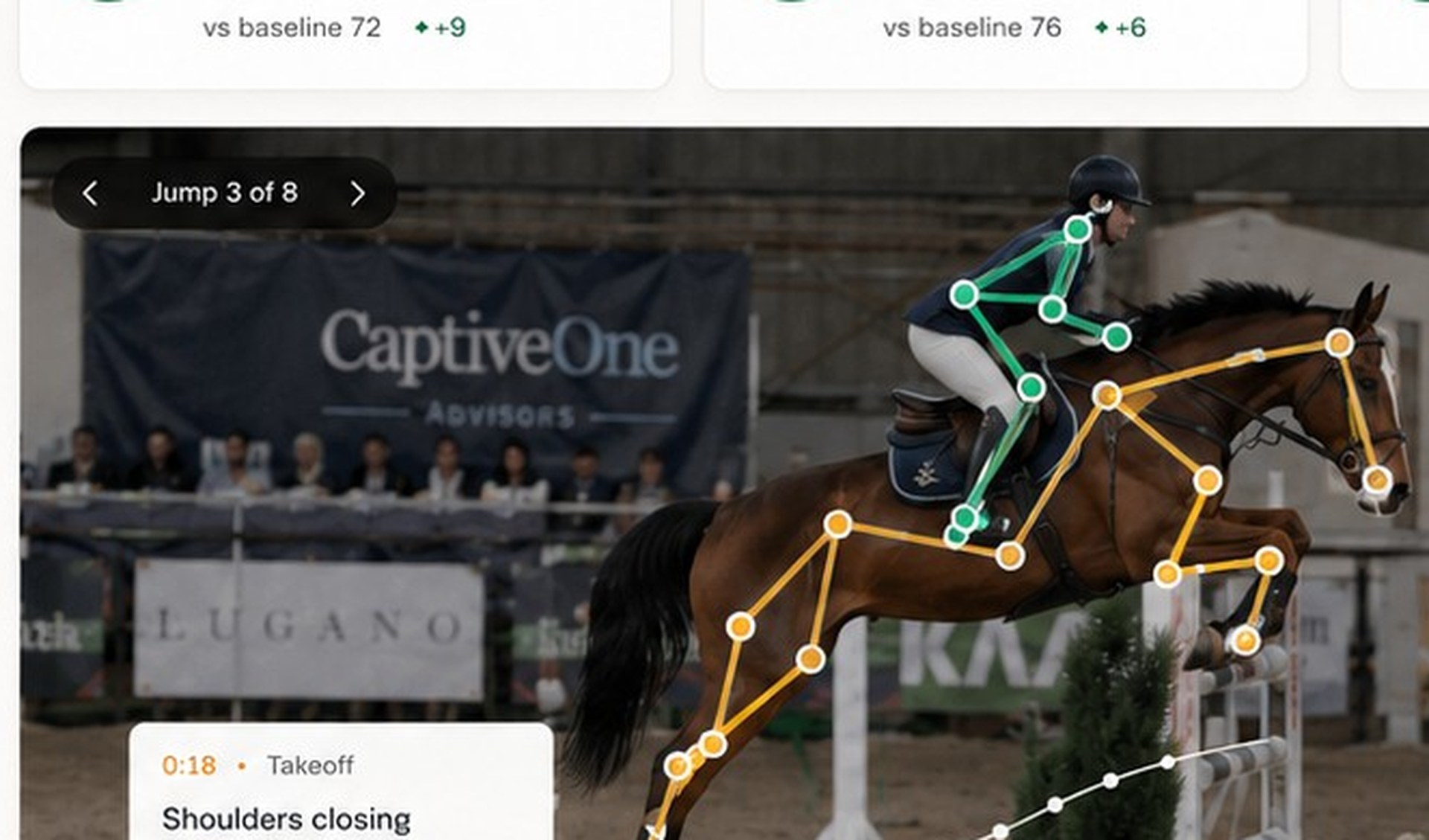
What your replay looks like
Shoulders closing early on approach
- ·Shoulder angle at 0:18: -18° (ideal: 0° ± 10°)
- ·Upper body ahead of vertical by 12°
- ·Occurs 3.2m before takeoff
- ·Observed in 4 of 8 jumps (50%)
Reduces balance and limits ability to follow horse over the fence.
Keep shoulders parallel to the fence; stay tall into last stride.
“You ride your best on the days someone is watching with care. We made that someone available between every lesson.”
Hip closes to 108° on takeoff — inside George Morris's 95–115° two-point envelope. Heel dorsiflexion holds at 12° below toe through the bascule (USEF ideal 5–15°). Torso travels with the horse instead of being left behind.
Real angles. Real ideals. Honest coaching.
Bid farewell to guesswork. Every frame is read against published USEF and FEI biomechanics ranges — head carriage, shoulder angle, elbow flex, hip closure, knee bend, heel position. You see precisely where you sit on the curve between “needs work,” the average rider at your level, and an ideal body position.
A coaching report a USEF judge could read.
Specific. Timestamped. Tied to a drill. Each observation cites a moment in the round, names the biomechanic at play, and ends with a concrete fix you can take to the next ride.
Rider position — heel, leg, hands, seat
Frame-by-frame check on ear–shoulder–hip–heel alignment, automatic release quality, lower-leg stability at the base, hand and elbow position, eyes up vs eyes down.
Horse mechanics — bascule, rhythm, stride
Bascule shape over each fence, takeoff spot accuracy, stride length in related distances, landing on correct lead, rhythm consistency in mpm.
Every fence, scored separately
Approach. Takeoff. Position. Form. Landing. Each effort gets its own breakdown so you know which fences to study and which to leave alone.
Progress across rides
Track the metrics that matter — lower leg stability, rhythm, horse-rider harmony, distance accuracy — across every round you upload.
A drill for every fault
Every observation comes with a specific exercise — gymnastics, no-stirrup work, trot poles, counter-canter — so the homework writes itself.
Phone, GoPro, ring camera
Any video your trainer already records works. MP4, MOV, WebM. No special equipment, no extra setup.
Hunter, jumper, equitation, dressage, eventing — each judged its own way.
The same round looks different to a hunter judge, a jumper steward, and a dressage TD. The AI applies the right rubric for the test you actually ride.
Hunters
Pace, jumping style, smoothness, automatic-release quality. Scored against USEF hunter standards.
Jumpers
Speed control, distance accuracy, rhythm in lines, jumping form. Visible faults flagged against the FEI fault table.
Equitation
Position over fences and on the flat: ear-shoulder-hip-heel, hand position, base of support, leg discipline.
Dressage
Movement-by-movement against the FEI 0–10 collective marks scale — rhythm, suppleness, contact, impulsion, straightness, collection.
Eventing
Dressage tests, show jumping rounds, cross-country segments — each phase analyzed against its own rubric.
What lands in your inbox after a round.
Specific. Timestamped. Tied to a drill. Every observation in the sample below was generated from a real 1.15m schooling round.
Shoulders closed 8° early on the approach to fence 2 — hip angle dropped before the takeoff.
Quiet automatic release at fence 3 — best jump of the round, replicate this feel.
Lower leg slipped 6 in. behind hip on landing of fence 4 — heel under hip drill.
Cadence dropped 32 mpm through the 5-stride bending line.
Track held straight to the oxer at fence 6 — 14% improvement over last session.
The same rubrics judges use — applied to your video.
We don't make up numbers. Scores reference published standards: USEF Equitation 0–100 bands, FEI Dressage 0–10 collective marks, FEI show-jumping fault table, and skill- level medians per metric (Beginner through Professional).
USEF Equitation
0–100| 90–100 | Excellent |
| 80–89 | Very good |
| 70–79 | Good |
| 60–69 | Average |
| < 60 | Below average |
FEI Dressage
0–10 per movement| 10 | Excellent |
| 8 | Good |
| 6 | Satisfactory |
| 4 | Insufficient |
| 2 | Bad |
Show Jumping faults
penalty table| Rail down | 4 faults |
| 1st refusal | 4 faults |
| 2nd refusal | Elimination |
| Fall | Elimination |
| Time | 1 per sec over |
It's like a second set of expert eyes between every lesson. Riders fix things on Tuesday that I would have flagged on Saturday.
The jump-by-jump breakdown closed the gap between my schooling rounds and my classes. Every fence is a coaching moment now.
We used to record rounds and rewatch them blind. Now those videos turn into homework with answers.
Your next round deserves
a real coaching report.
Two minutes from upload to an AI-judged, frame-by-frame report. No special equipment. Any video your trainer already records.